

That dotted line on your property plan isn't a "keep out" sign or a defect that ruins your investment. It's a vital piece of land data that, when understood correctly, ensures your purchase is secure and compliant. Clarity. It's the most important tool in your property search. We know it's easy to feel overwhelmed by legal jargon or worry that an easement might lead to the council tearing down your new deck. You're likely looking for a smooth settlement without the fear of future devaluations or unexpected council disputes.
We'll help you swap that confusion for clarity. You'll discover exactly how these land rights affect your building plans and property value in plain, jargon-free Australian English. We'll preview the latest 2026 updates, including the new electricity infrastructure laws and specific local council policies like the Bayside drainage rules or the current $175.10 building application fee in Monash. By the end of this guide, you'll have the confidence to navigate your settlement process and protect your investment for the long term.
• Terminology. Understand the difference between dominant and servient tenements to see exactly who holds rights over your land.
• Local Insights. Identify common drainage and electricity easement types frequent in Geelong and the Bellarine Peninsula.
• Building Compliance. Learn why certain structures require specific permissions and how to avoid the risk of forced demolition.
• Contract Review. Master the art of spotting 'E' markings on a Plan of Subdivision and reviewing Section 32 statements with precision.
• Investment Security. Discover how expert title reports and professional conveyancing protect your property's future resale value.
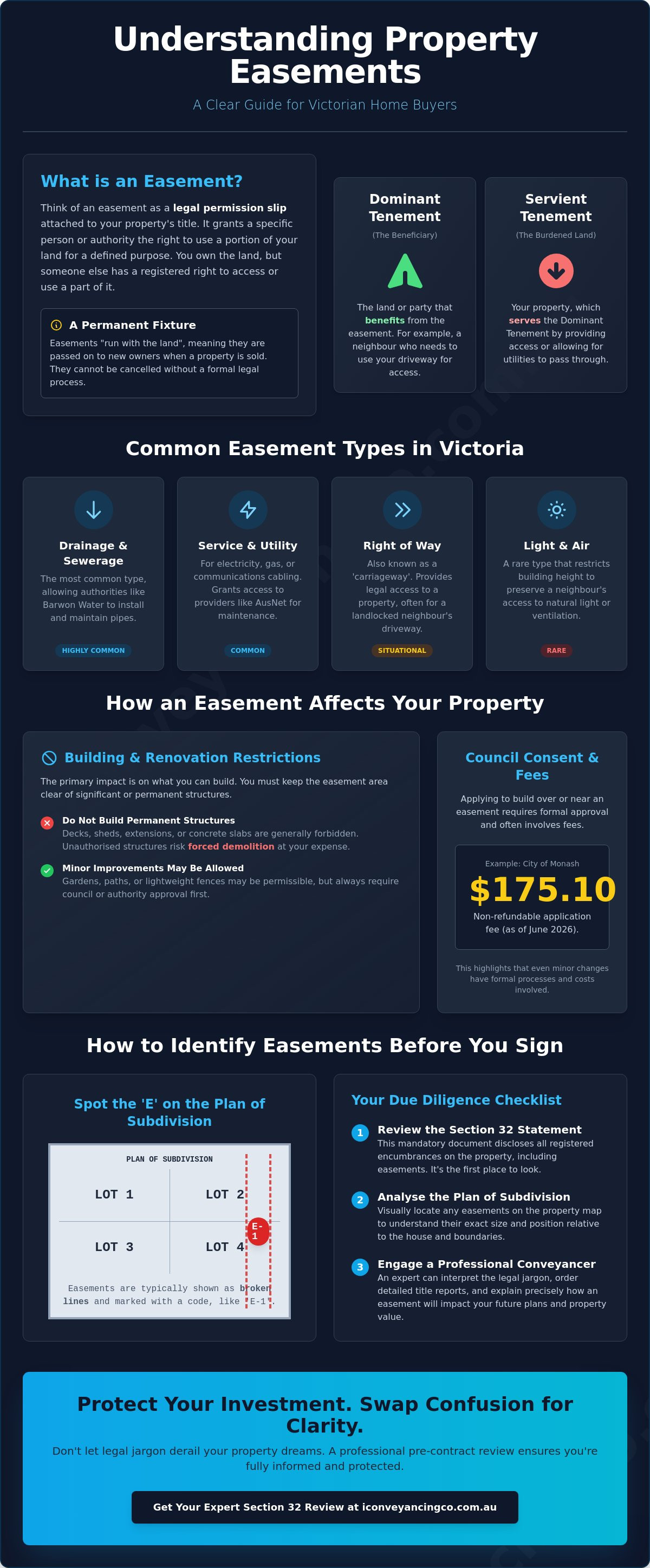
Clarity. An easement is essentially a legal permission slip attached to your property title. It grants a specific person or authority the right to use a portion of your land for a defined purpose. If you're asking what is an easement? in a practical sense, think of it as a shared space where you own the dirt, but someone else has a right to be there. This could be for a backyard sewer pipe or a shared driveway. In Victoria, these rights are common and don't necessarily mean there's a problem with the property.
Understanding the relationship between parties is the first step toward confidence. Property law uses two specific terms to describe this. The Dominant Tenement is the land or party that benefits from the easement, such as a neighbour who needs to drive across your block to reach their own. The Servient Tenement is your land, which "serves" the other party by providing that access. It's a simple give-and-take relationship recorded on the title to prevent future disputes.
It's a permanent fixture. These rights "run with the land", meaning they don't disappear when the property is sold. When you settle on a home in St Leonards or Geelong, you're stepping into the existing legal framework of that title. Whether it's a drainage line for Barwon Water or a carriageway for a landlocked neighbour, the right stays put. You can't simply "cancel" it because you've moved in; it remains a part of the land's DNA until it's formally removed through a legal process.
Infrastructure. Most easements exist to ensure the community functions smoothly. Land Use Victoria registers these interests to guarantee that essential services like water, gas, and electricity can reach every home. Without them, a single property owner could block a whole street's access to drainage. They also protect "right of way" access. This ensures that if a parcel of land is tucked away behind another, the owner still has a legal path to the public road. It's about fairness and functional urban planning.
Authorities. Public easements are usually held by councils or service providers like AusNet. These are often for sewerage or power lines and are vital for city maintenance. Private easements are different. These are agreements between two neighbours, such as a shared wall or a private pipe. You'll find both types clearly marked on your Plan of Subdivision. They're usually denoted by broken lines and specific codes, showing you exactly where your building plans might need to flex to accommodate these existing rights.
Local knowledge matters. When you're looking at property on the Bellarine Peninsula, you'll find that certain land rights appear more frequently than others. These aren't just legal footnotes; they determine where you can place a garden shed or how much privacy you'll have from your neighbours. Understanding these common types helps you move through the settlement process with a clear head and a realistic plan for your new home.
Drainage and sewerage are the most common encounters for buyers in our region. These ensure that Barwon Water can maintain the infrastructure that keeps the community healthy. You might also see a wayleave or electricity easement. These are becoming more topical following the Energy and Other Legislation Amendment (Resilience Reforms and Other Matters) Act 2026, which received Royal Assent on 11 March 2026. This law allows for the compulsory acquisition of easements for major electricity transmission projects to happen faster, highlighting how vital these utility corridors are for Victorian infrastructure.
Less common but equally impactful are easements of light and air. These rare restrictions prevent you from building to a height that would block a neighbour's natural light or ventilation. If you're unsure how these specific markings on a title might limit your renovation dreams, getting a pre-contract Section 32 review is a proactive way to protect your investment.
Authorities need access. Most utility easements are "in gross," meaning they benefit a specific organization like a council or water authority rather than a neighbouring piece of land. Barwon Water or AusNet may require access to your backyard to repair pipes or cabling. You're generally required to keep these areas clear of permanent structures. If you're in the City of Monash, for example, applying to build over such an area carries a non-refundable fee of $175.10 as of June 2026, showing that even small changes require formal approval and a clear paper trail.
Battle-axe blocks are a staple of St Leonards subdivisions. These often rely on a carriageway easement, which is an unrestricted right of way allowing a neighbour to drive across your land to reach their own. While you own the land, you cannot block it or install gates that impede their access. Maintenance is usually a shared responsibility, but it's vital to check the specific "Unrestricted Right of Way" clause in your contract to see who pays for the gravel or bitumen upkeep. This clarity prevents awkward conversations over the fence later on.
Constraints. The presence of an easement on your title isn't a deal-breaker, but it does demand a shift in how you view your land. While you own the soil, your rights to use it are balanced against the rights of the authority or neighbour who holds the interest. This balance affects everything from where you can plant a lemon tree to the final figure on your bank's valuation report. Understanding this "benefit versus burden" dynamic is essential for any long-term investment strategy in St Leonards or the wider Geelong region.
Maintenance obligations are a critical, often overlooked responsibility. You are legally required to keep the area clear and accessible for the party that holds the right. Obstructing this access can be expensive. For instance, the Bayside City Council Drainage Easement Policy, adopted on 17 February 2026, specifies that hindering an authorised officer's access can result in a fine of up to 60 penalty units. For the 2025/2026 financial year, this amounts to approximately $12,210. While this policy is specific to Bayside, it reflects a broader Victorian trend toward strict enforcement of access rights.
Value. It's the first question most buyers ask. Does a standard easement lower the sale price? Generally, if the restriction is a typical 2-metre drainage line along the rear boundary, the market has already "priced it in." However, if a large utility corridor cuts through the centre of a block, it limits the building footprint. This can reduce the property's appeal to developers or families wanting a large pool, potentially impacting the resale potential compared to a completely clear title.
Permission. You cannot simply build over a restricted area without a "Report and Consent" from the relevant authority. Councils and water boards generally prefer demountable structures, like a garden shed or a deck, rather than permanent concrete foundations. The risk is real; if a utility provider needs to repair a pipe under your structure, they have the legal right to remove it. If you haven't secured the proper permits, the cost of that removal and any subsequent repairs falls entirely on your shoulders.
Transparency. Most buyers aren't deterred by standard service lines, provided they are disclosed early. In Victoria, these are considered "material facts" that must be clearly outlined in the Section 32 Vendor Statement. A proactive conveyancer doesn't just point out the line on the map; they explain the practical reality to prospective purchasers. This clarity builds trust and ensures the settlement process remains smooth, preventing last-minute jitters that can derail a sale.
Precision. Finding an easement on a title isn't a matter of luck; it's a matter of thorough due diligence. In Victoria, the legal framework is designed to provide transparency, but the information is often buried deep within technical documents. You need to know exactly where to look to avoid surprises after you've committed your deposit. Most buyers start with a visual inspection of the backyard, but the real story is always in the digital records held by Land Use Victoria.
A Title Search is your starting point. This document lists all registered "instruments" or encumbrances that affect the land. It's essential that this search is recent; industry standards suggest it should be less than 90 days old to ensure accuracy. Modern systems like the Vicmap Property database, which was last updated in May 2026, provide a detailed spatial dataset of all approved and proposed easements across the state. Using these digital tools allows us to verify the current status of the land before you sign on the dotted line.
Implied easements are the hidden layer. Under Section 98 of the Subdivision Act 1988, certain rights for drainage, sewerage, or even the passage of electricity can exist even if they aren't explicitly drawn on the plan. These "implied" rights are just as legally binding as the ones you can see. If you're looking at a property in an established area like Geelong, these invisible lines are almost guaranteed to exist. Identifying them early ensures you don't accidentally plan a swimming pool directly over a vital community pipe.
Disclosure. The Section 32 Vendor Statement is where the seller must list any encumbrances. Look specifically at the "Notices, Councils and Authorities" section. This part of the document should include any letters or maps from service providers like Barwon Water. Because these documents are often dense with legal terminology, Fiona Barber's expert contract review is essential before signing. We translate the "legalese" into a clear explanation of what you can and cannot do with the land, giving you the confidence to proceed or negotiate.
Geometry. The Plan of Subdivision is a bird's-eye view of your block. You're looking for broken lines, often marked with an 'E' followed by a number, such as 'E-1' or 'E-2'. These markings correspond to a table or "Legend" on the first or second page of the plan. This table defines the width of the area and its specific purpose, whether it's for "Drainage and Sewerage" or "Carriageway". Cross-referencing these visuals with the Title Search ensures that what's on the map matches what's registered with the state government. If you need a fast turnaround on these documents, we recommend a pre-contract urgent Section 32 review to keep your purchase on track.
Reliability. With over 20 years of experience navigating Victorian property law, we've guided thousands of buyers through the complexities of land titles. An easement doesn't have to be a source of stress when you have a qualified expert reviewing the fine print. We provide the calm, transparent advice needed to understand how these registered interests affect your specific plans for the property. Our team acts as your proactive partner, ensuring every disclosure in the Section 32 is scrutinised for accuracy and long-term impact.
We take the lead in liaising with local councils and service authorities on your behalf. If there's a question about building over a drainage line in Geelong or accessing a shared driveway in St Leonards, we get the answers directly from the source. This professional transparency ensures your settlement is not just a transaction, but a fully informed investment. We focus on the technical details so you can maintain your peace of mind throughout the entire property transfer. Our goal is to remove the administrative burden, leaving you free to plan your move with total confidence.
Accuracy. We use modern, tech-savvy systems to monitor updates from Land Use Victoria and the Vicmap database. This ensures the information we provide is current and reflects the latest regulatory changes, such as the 2026 amendments to electricity infrastructure laws. By bridging the gap between traditional legal expertise and contemporary digital accessibility, we offer a service that is both highly compliant and exceptionally convenient for the modern buyer.
Clarity. Our personalised reviews highlight exactly where your building plans might clash with existing land rights. We understand that your time is valuable. That's why we offer mobile and remote services that bring our expertise to you, wherever you are on the Bellarine Peninsula. We translate complex 'legalese' into plain English, ensuring you never feel left in the dark about the "E" markings on your plan or the fine print in your vendor statement. It's about giving you a clear path forward.
Predictability. We handle the heavy lifting of the administrative process, from conducting the initial Title Search to managing the final exchange of funds through digital settlement platforms. Our fixed-fee model provides the financial certainty you need during a move, with no hidden costs appearing at the final hour. We're committed to a smooth, efficient experience that prioritises your convenience and protects your investment. If you're ready to start your property journey with a team that values honesty and clear communication, book your contract review today.
Clarity. You now understand that an easement is not a property flaw, but a vital piece of land data that shapes your future building plans and property rights. By identifying these registered interests early and decoding the technical markings on your Plan of Subdivision, you remove the guesswork from your investment. You're now equipped to navigate the settlement process in Geelong or St Leonards without the fear of unexpected council disputes or hidden restrictions.
Expertise. Licensed Conveyancer Fiona Barber brings over 20 years of Victorian property experience to your purchase. We act as your proactive partner, offering fixed-fee transparency and jargon-free advice that prioritises your peace of mind. We handle the complex title reports and authority liaisons so you don't have to. Secure your property investment with a professional contract review today. Your journey toward a successful settlement starts with the right information and a reliable guide by your side. We look forward to helping you move into your new home with total confidence.
Yes, it's possible. Removing an easement requires a formal legal process under the Transfer of Land Act 1958 or the Subdivision Act 1988. You usually need the consent of the party that benefits from the right, such as a neighbour or a local council. If they agree the right is no longer required, an application is lodged with Land Use Victoria to formally update your title.
In cases where parties don't agree, you may need to apply to the Supreme Court. The court generally requires proof that the right has been abandoned or is no longer necessary for the dominant land. This process involves legal costs and specific evidence, so it's best to seek expert advice before starting.
You risk a forced demolition. If a utility provider needs to access the infrastructure beneath your shed, they have the legal right to remove the structure at your expense. Without a "Report and Consent" from your local council, you're also likely to face difficulties when you eventually try to sell the property, as the illegal structure will be flagged during the buyer's due diligence.
Compliance is the safest path. Even if the shed is a "demountable" kit, most authorities still require you to sign an agreement acknowledging that they aren't liable for any damage caused if they need to enter the area for emergency repairs. It's a small administrative step that protects your long-term investment.
Yes, you're responsible for the rates on the entire property. Even though an authority or neighbour has the right to use a specific portion of your land, you remain the legal owner of the soil. The Valuer-General includes the area covered by the easement when determining the property's capital improved value, which councils use to calculate your annual rates.
Precision starts with your Plan of Subdivision. This map, found within your Section 32, uses measurements from your property boundaries to show the exact location and width of any restricted areas. It's the most reliable way to see how much of your backyard is affected before you start designing a new patio or pool.
For absolute certainty on the ground, you can hire a licensed land surveyor. They'll use the title dimensions to "peg out" the area, showing you exactly where the lines sit in relation to your existing fences or garden beds. This is a proactive way to ensure your landscaping stays within legal limits.
A Right of Way is a specific type of easement. While all Rights of Way are easements, not all easements are Rights of Way. The term "easement" is a broad legal category for a right to use land for a defined purpose, whereas a Right of Way specifically gives someone the legal path to travel across your land to reach their own property.
Generally, no. Most standard service easements for drainage or sewerage are common in Victorian suburbs and won't bother a lender. Banks see these as a normal part of urban infrastructure. However, if a restriction is so large that it severely limits the building envelope, a bank's valuer might adjust the property's estimated value accordingly.
The property owner is usually responsible for the surface maintenance. You're required to keep the area clear of debris, overgrown vegetation, or unapproved structures that could block access. While the relevant water authority maintains the actual underground pipes and assets, you must ensure the land above remains accessible and functional for the system.
In certain circumstances, yes. If a neighbour can prove that an easement is reasonably necessary for the effective use or development of their land, they can apply to the Supreme Court or VCAT for a grant of access. This often happens in cases of landlocked blocks or essential drainage requirements. If the court grants the right, the neighbour is typically required to pay you fair compensation for the impact on your land.