

A single error in your vendor statement can give a buyer the legal right to walk away from your property sale at any time before settlement. It's a sobering thought for any homeowner, but the reality is that precision is your best protection. Most sellers feel a mix of confusion and stress when faced with the technical requirements of a section 32 victoria, particularly when navigating the pressure of an upcoming auction or complex legal jargon. You want the certainty that your paperwork is bulletproof so you can focus on the move ahead without fear of a last-minute collapse.
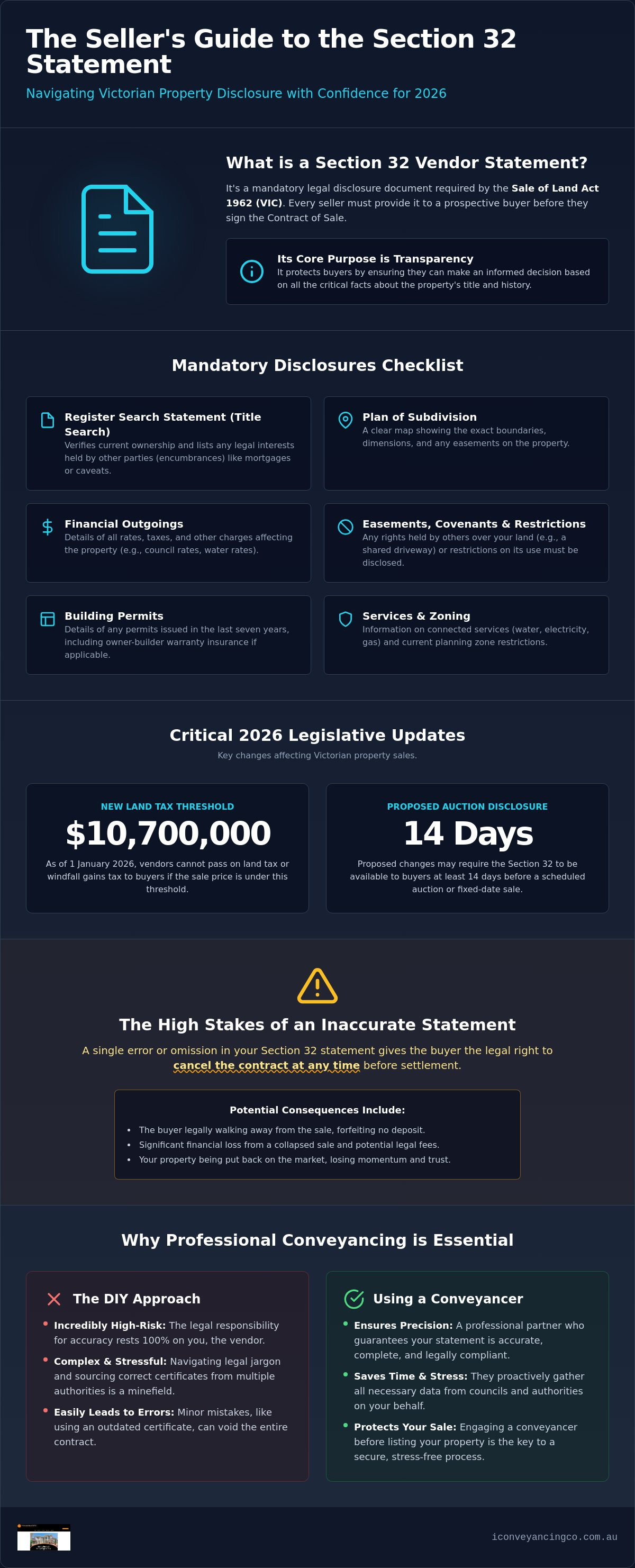
This 2026 guide provides everything you need to manage your disclosure obligations with confidence and clarity. We'll explain the $10,700,000 land tax threshold, the proposed 14-day disclosure period for auctions, and the updated rules regarding deposit releases under the Consumer Legislation Amendment Bill. By the end of this article, you'll have a clear path to a valid, compliant document that secures your sale and ensures a smooth journey to settlement day.
• Understand why the section 32 victoria is your most important legal disclosure and how it protects your sale from being rescinded.
• Identify the essential documents you must include, from title searches to subdivision plans, to avoid costly technical errors.
• Learn about the severe financial and legal risks of providing inaccurate information, including the buyer's right to walk away before settlement.
• Discover why engaging a conveyancer before listing your property is the key to a stress-free and efficient selling process.
• Stay informed on critical 2026 changes, including the new land tax threshold and updated disclosure requirements for public auctions.
A section 32 victoria is a mandatory legal disclosure document that every seller must provide to a prospective buyer. It's commonly known as a Vendor Statement. This requirement is governed by the Sale of Land Act 1962 (VIC), which mandates that specific information about a property's title and history must be shared before a sale can proceed. The core purpose is simple: transparency. By providing this information upfront, the law protects consumers and ensures that buyers can make an informed decision based on facts rather than assumptions.
Timing is critical in this process. You must provide the statement to a buyer before they sign the Contract of Sale. Under the 2026 legislative updates, this often means making the statement available at least 14 days before a scheduled auction or fixed-date sale. If you fail to do this, or if the information provided is incomplete, the buyer may have the legal right to rescind the contract. It's a powerful consumer protection tool that keeps the Victorian property market fair and predictable for everyone involved.
While people often talk about them in the same breath, these are two distinct documents with different jobs. The Contract of Sale is the actual agreement. It sets out the price, the deposit amount, and the settlement date. The Section 32 is the disclosure that sits behind that agreement. It's a prerequisite for a valid sale. In Victoria, a Contract of Sale is generally not legally binding unless a valid Section 32 is attached and has been properly disclosed. Understanding What is Conveyancing helps clarify this relationship; it's the process of ensuring all legal obligations are met so the title can transfer safely. The Vendor Statement always comes first in the sequence of delivery to ensure the buyer knows exactly what they are purchasing.
The legal obligation to provide an accurate statement rests entirely with the vendor. You're responsible for the information within, even if you weren't personally aware of a specific detail. This is why a DIY approach is incredibly high-risk. Technical errors or missing certificates in your section 32 victoria can lead to voided contracts and significant financial loss. Most successful sellers choose to work with a qualified professional to manage this burden. A conveyancer acts as a proactive partner, gathering data from various authorities. They contact bodies like the City of Greater Geelong or local water authorities to pull together the most current records. This professional precision protects your sale and ensures you meet your legal obligations without the stress of managing complex administrative hurdles yourself.
A valid section 32 victoria is more than just a single page; it's a comprehensive bundle of certificates and legal disclosures. Each document serves a specific purpose, ensuring the buyer is fully aware of any restrictions or financial burdens attached to the land. Accuracy here is non-negotiable. If you omit a required certificate or provide outdated information, you risk the entire sale falling through. Following the Consumer Affairs Victoria guidelines is the best way to ensure your disclosure meets the strict standards set by the Sale of Land Act.
The list of mandatory inclusions is extensive. At a minimum, your statement must include a current Register Search Statement (Title Search) and a clear Plan of Subdivision. You must also disclose financial outgoings. As of 1 January 2026, vendors cannot pass on land tax or windfall gains tax to buyers if the sale price is under the threshold of $10,700,000. This is a significant shift in Victorian property law that requires careful attention during the preparation of your documents. Additionally, if you've completed building works in the last seven years, you must provide the relevant permits and owner-builder insurance details.
This part of the statement identifies any "encumbrances" on the property. These are legal interests held by other parties, such as mortgages, caveats, or liens. Most of these must be discharged at settlement to provide the buyer with a "clear title." Easements are another critical disclosure. If a sewer pipe runs under your backyard or a neighbour has a right of way through your driveway, it must be clearly marked. In Geelong and the Bellarine Peninsula, many older lots have unique covenants or restrictions that dictate what can be built on the land. Missing these details is a common reason for contract disputes.
You must explicitly state which services are connected to the property. This includes electricity, gas, water, sewerage, and telephone services. A common pitfall for sellers in coastal areas like St Leonards and Portarlington is assuming that "available" means "connected." If a physical connection doesn't exist, you must disclose it. Buyers often rely on this information to calculate their move-in costs. If you're feeling overwhelmed by the technical requirements of these disclosures, our team can help you organise your selling properties conveyancing to ensure every utility and service is correctly recorded.
If you're selling an apartment, townhouse, or a property with a shared driveway, you'll likely be part of an Owners Corporation (formerly known as a Body Corporate). This adds another layer of mandatory paperwork. You must provide an Owners Corporation Certificate, which details current fees, insurance coverage, and any liabilities. It's also standard practice to include the last two years of meeting minutes. These documents reveal the "health" of the complex, including any upcoming special levies for major repairs or maintenance funds that the buyer will be responsible for after settlement.
Precision is your best defence when selling property. A section 32 victoria that contains even a minor technical error is more than just a nuisance; it's a legal liability. If your disclosure is flawed, you essentially hand the buyer a "get out of jail free" card. This vulnerability can lead to the total collapse of a sale, often at the most inconvenient moment. Beyond the risk of a cancelled contract, providing false or misleading information can result in significant financial penalties under the Sale of Land Act. Accuracy ensures your sale remains binding and your financial future stays secure.
Errors also have a devastating impact on your marketing campaign. If a mistake is discovered while your property is on the market, your agent may have to pause inspections or notify every interested party of the correction. This creates doubt in the minds of buyers and can kill the momentum of a competitive auction. Using a licensed conveyancer mitigates these risks. Professional practitioners carry Professional Indemnity insurance, providing a layer of financial protection that a DIY seller simply cannot access. This insurance acts as a final safety net, ensuring that your interests are protected throughout the entire transaction.
The legal grounds for a buyer to exit a contract are surprisingly broad. Under Section 32(5) of the Act, a buyer may rescind the contract at any time before settlement if the vendor has failed to provide the required information or has provided inaccurate details. This is distinct from the standard three-day cooling-off period. A buyer can potentially walk away weeks after signing if they discover a non-disclosure. While there are some limited protections for sellers who make "honest and reasonable" mistakes, these are difficult to prove in court. The nightmare scenario of losing a sale days before settlement is a reality for those who treat their section 32 victoria as a mere formality.
Most contract disputes arise from avoidable oversights. Failing to disclose an unregistered easement, such as a hidden drainage pipe, is a frequent cause for rescission. Similarly, using outdated certificates can lead to compliance issues. Most certificates should be no older than 90 days to be considered reliable. Another common pitfall involves DIY renovations. If you built a deck or pergola in the last seven years without the required permits, this must be explicitly disclosed. Omitting these details gives the buyer clear leverage to terminate the agreement, regardless of how much they initially liked the home.
Organising your paperwork shouldn't feel like a race against time. A structured approach ensures every detail is captured without the last-minute panic often associated with property sales. By following a clear sequence, you can transform a complex legal requirement into a straightforward administrative task. Most sellers find that starting this process early provides the peace of mind needed to focus on the presentation of their home.
The preparation of a section 32 victoria follows five essential steps:
Ideally, this should happen before you call a real estate agent. Early engagement allows your representative to start the search process, which can take several business days depending on local council response times.
Gather recent council rates notices, water bills, and any documentation for renovations or structural repairs completed in the last seven years. Having these ready saves significant time during the initial data collection phase.
Your conveyancer will contact state and local authorities to obtain the most current information regarding zoning, land tax, and planning overlays. This ensures your statement is accurate and compliant with the latest 2026 standards.
We provide a draft for your inspection to ensure no local nuances, like an informal agreement with a neighbour or a specific property quirk, have been overlooked.
Once finalised, your agent can legally begin marketing the property and providing the statement to prospective buyers.
Auction campaigns in Geelong and the Bellarine Peninsula move quickly. Buyers expect to see a "ready to go" document the moment they express interest. If your paperwork is delayed, you risk missing the peak of market interest or being forced to postpone your auction date. We specialise in Pre - Contract Urgent Section 32's to meet these tight deadlines. We understand the pressure of a four-week campaign and act responsively to ensure your sales momentum isn't lost. This proactive approach helps lower stress levels for both you and your agent.
Transparency is the foundation of a stress-free sale. It's helpful to distinguish between professional fees and disbursements. Professional fees cover the expertise and time your conveyancer spends preparing the documents. Disbursements are the actual costs charged by authorities for the certificates themselves. We believe in fixed price conveyancing to provide sellers with financial predictability. Knowing your costs upfront allows you to plan your budget with confidence. If you're ready to move forward, we can help you get started with your selling properties conveyancing today.
Navigating the Victorian property market requires more than just filling out forms. It's about risk management and strategic protection. With over 20 years of experience in the industry, Fiona Barber and the i.Conveyancing.Co team provide a level of oversight that a DIY approach simply cannot match. A section 32 victoria prepared with professional precision acts as your primary legal shield. It ensures that your disclosure obligations are met with absolute accuracy, preventing buyers from finding the technical loopholes discussed in earlier sections. We combine this deep industry history with modern, streamlined digital processes to make your transaction as efficient as possible.
Efficiency. We use the latest digital platforms to ensure your documents are prepared quickly and signed securely from the comfort of your home. This tech-savvy approach doesn't come at the expense of personalised care. We remain a proactive partner throughout your journey, moving quickly to resolve administrative burdens before they reach your desk. Our focus is on saving you time and providing financial predictability through our transparent service model. By choosing an expert, you gain a guide who understands the high stakes of a Victorian property sale and values your peace of mind above all else.
Every region has its own administrative rhythms and property quirks. Dealing with the City of Greater Geelong or Barwon Water requires an understanding of their specific requirements to avoid delays. If you're selling a coastal home on the Bellarine Peninsula, properties in Portarlington or St Leonards often involve unique environmental overlays or specific bushfire requirements that must be disclosed. These details aren't always obvious on a standard title search. As a Conveyancer Geelong specialist, we apply this local lens to every document we prepare. We know which questions to ask and which authorities to contact to ensure your section 32 victoria is bulletproof against local challenges.
Clarity. We translate complex "legalese" into clear, actionable advice so you always know where you stand. Our role is to lower your stress levels by presenting the conveyancing process as a series of manageable steps. We take a proactive stance by identifying potential issues, such as unregistered caveats or expiring certificates, well before they can threaten your settlement date. This forward-thinking approach is a core part of our service, ensuring you feel supported and informed at every turn. You can find more detail on how we protect your interests in our Section 32 Vendor Statement Guide, which outlines our commitment to transparent and reliable property disclosures.
A successful sale starts with a bulletproof disclosure. You now understand that your statement is more than a formality; it's a legal requirement that protects your transaction from rescission. By staying ahead of the 2026 land tax thresholds and meeting the new 14-day auction disclosure rules, you ensure your path to settlement is clear and predictable. Precision in these details removes the risk of technical errors and gives you the confidence to move forward with your next chapter.
Managing your section 32 victoria doesn't have to be a source of stress. With over 20 years of Victorian property experience, our team provides the expert oversight needed for a seamless sale. Whether you require mobile and remote services across Geelong and the Bellarine or need an urgent document prepared for a fast-tracked auction campaign, we act as your proactive partner. We focus on the legal complexities so you can focus on the move. Get a stress-free Section 32 prepared by i.Conveyancing.Co today. We look forward to helping you achieve a smooth and successful settlement.
A section 32 victoria doesn't have a specific expiry date set by law, but its validity depends on the currency of the certificates within it. Most authorities and legal practitioners consider certificates older than 90 days to be outdated. If your property stays on the market for several months, you'll likely need to refresh these documents to ensure your disclosures remain accurate and legally compliant for a new buyer.
No, you cannot legally sell a property in Victoria without providing a valid Vendor Statement. This document is a mandatory requirement under the Sale of Land Act 1962. Attempting to sign a Contract of Sale without one makes the contract unenforceable and gives the buyer the immediate right to walk away from the deal before settlement. It's the vendor's primary legal obligation to provide this information before any binding agreement is reached.
The seller is responsible for the cost of all certificates required to prepare the statement. These costs are known as disbursements and are separate from professional conveyancing fees. While the seller pays for these upfront, a properly prepared document protects the sale and prevents the much higher costs associated with a failed transaction or legal dispute. It's a necessary investment in the security and transparency of your property sale.
The cooling-off period is a three-business-day window where a buyer can cancel a contract for a small fee. This is entirely separate from the rights associated with the section 32 victoria. While cooling-off is a short-term choice for the buyer, a defective Vendor Statement gives the buyer a much broader right to rescind the contract at any point before settlement day, regardless of whether the cooling-off period has ended.
You don't necessarily need a brand-new document, but you must ensure the existing one remains accurate. If your property goes back on the market after a failed auction, your conveyancer should check if any certificates have expired or if new notices have been issued by local council. Keeping the document current ensures that a subsequent private sale remains legally binding and secure for both you and the prospective purchaser.
You must disclose the error to the buyer as soon as it's discovered. Depending on the nature of the mistake, the buyer may have the legal right to rescind the contract and walk away from the sale. In some cases, an amendment can be negotiated through a deed of variation, but this requires the buyer's consent. This highlights why professional preparation is so critical to avoid these stressful post-signing complications.
Yes, if the property has been the subject of a formal notice from the police or council regarding a clandestine laboratory, it must be disclosed. Similarly, while there's no general requirement to list all asbestos, any specific health or building notices related to asbestos on the property must be included. General material facts that might influence a buyer's decision should always be handled with transparency to ensure a valid sale.
No, a building inspection report is not a mandatory part of the Vendor Statement. The focus of the Section 32 is on legal title, zoning, and financial outgoings rather than the physical condition of the structure. Buyers are responsible for organising their own building and pest inspections to satisfy themselves regarding the property's physical state before they commit to the purchase. We always recommend buyers perform their own due diligence.