

A single paperwork error can cost you a sale and thousands in legal penalties before the "Sold" sticker even hits the board. It's a high-stakes process where a minor oversight in your documentation gives a buyer the legal right to walk away. Selling your home is one of the most significant financial moves you'll ever make; it's natural to feel a bit overwhelmed by the shifting landscape of Victorian property law. Understanding the legal requirements for selling a house in victoria is the only way to ensure your settlement stays on track and your financial interests remain protected.
This 2026 guide provides a clear, stress-free roadmap to help you manage everything from the updated $50,000 land tax threshold to the mandatory Section 32 disclosures. We'll break down the essential documents you need to have ready, the latest tax changes you can't ignore, and how to avoid the common traps that cause settlement delays. You'll gain complete transparency on your obligations so you can move forward with total confidence and peace of mind.
• Gain a clear understanding of the Sale of Land Act 1962 and how it defines your specific legal obligations as a vendor in Victoria.
• Navigate the legal requirements for selling a house in victoria by ensuring your Section 32 Vendor Statement is accurate and fully compliant.
• Protect yourself against contract rescission by proactively disclosing material facts about your property's history as required by state law.
• Prepare for a smooth transition by organising your Certificate of Title and local council rates notices before you list the property for sale.
• Ensure a secure and efficient final handover through the PEXA digital settlement platform while your conveyancer handles the complex math of rate adjustments.
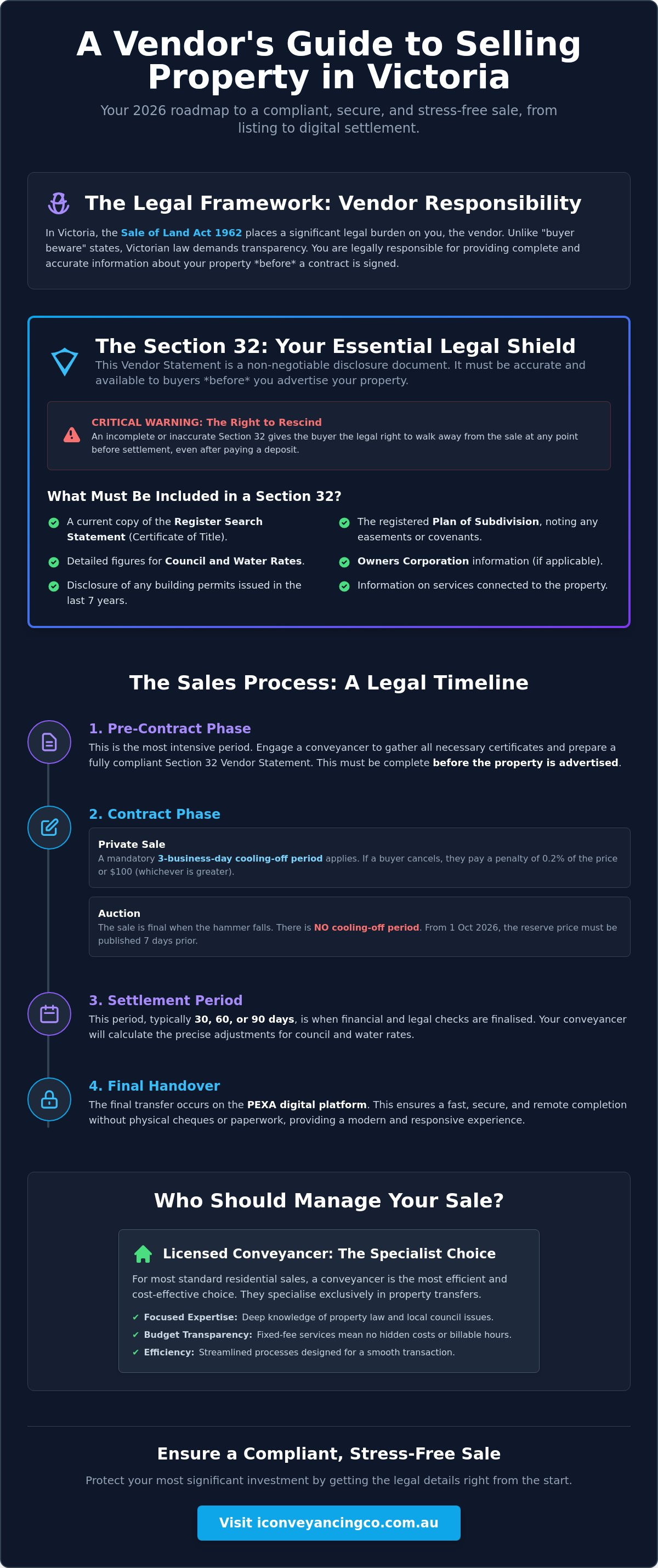
The Sale of Land Act 1962 forms the backbone of every residential transaction in Victoria. Unlike some other Australian states where "buyer beware" is the dominant rule, Victoria places a significant burden of transparency on the person selling the property. In legal terms, you are the "Vendor". This identity carries specific responsibilities that begin long before a contract is signed. You are legally responsible for the accuracy of the Section 32. If it's not complete or contains errors, the buyer may have the right to walk away from the sale at any point up until settlement day.
You cannot legally advertise a property for sale in Victoria without having a Section 32 Vendor Statement ready for inspection. This is a non-negotiable part of the Vendor disclosure law in Australia, specifically designed to protect consumers from hidden property defects or financial encumbrances. Meeting the legal requirements for selling a house in victoria starts with this document. It's the first step in a compliant sale process. Engaging a conveyancer before your first Open for Inspection is the smartest way to avoid delays. Modern Victorian law also protects buyers through a mandatory three-business-day cooling-off period for private sales. If a buyer chooses to cancel during this window, they must pay a penalty of 0.2% of the purchase price or $100, whichever is higher. These rules don't apply to properties bought at auction, where the sale is final once the hammer falls.
For standard residential sales in the Geelong and Bellarine region, a licensed conveyancer is often the most efficient choice. These professionals specialise exclusively in property transfers, providing a focused level of expertise. Opting for fixed-fee conveyancing ensures budget transparency. You'll know your costs upfront without worrying about billable hours or hidden administrative charges. Local knowledge is also vital. Understanding specific land title issues or easements unique to the City of Greater Geelong can prevent unexpected hurdles during the sale process.
The journey to a successful sale follows a structured path. The pre-contract phase is the most intensive period. This is when your conveyancer gathers the necessary certificates and prepares the Section 32. Once a buyer is found and the contract is signed, the focus shifts to the settlement period, which usually lasts 30, 60, or 90 days. The use of PEXA ensures the final handover is fast, secure, and completed remotely. This digital platform eliminates the need for physical cheques and manual paperwork, providing a modern and responsive experience for everyone involved. It’s also vital to remember that from October 1, 2026, new auction laws will require you to publish a reserve price seven days before the event, adding another layer of transparency to the process.
The Section 32 is a legal document provided by you, the vendor, to any prospective buyer before they sign a contract. It's often called the "Vendor Statement" because it serves as your formal declaration of the property's legal and financial status. In Victoria, providing this statement isn't just a courtesy; it's a non-negotiable part of the legal requirements for selling a house in victoria. Its primary purpose is to ensure complete transparency, giving the buyer all the facts they need to make an informed decision before they commit to the purchase.
Getting this document right is critical for the success of your sale. If a Section 32 is incomplete or contains significant errors, the buyer often has a legal right to walk away from the transaction at any time before settlement. This "rescission" can happen even if the buyer has already signed the contract and paid a full deposit. To avoid this risk, many sellers in fast-moving markets choose to organise a pre-contract urgent Section 32 to ensure they are ready for immediate offers. This proactive approach keeps the momentum of your sale alive while maintaining strict legal compliance.
The statement must contain a specific set of certificates and disclosures to be legally valid. Accuracy here is paramount. Your statement must include a current copy of the Register Search Statement and any registered Plan of Subdivision showing easements or restrictive covenants. You also need to provide detailed figures for council rates, water charges, and any owners corporation fees if the property is part of a strata scheme. Additionally, you must disclose how the land is zoned and provide details of any building permits issued in the last seven years. Finally, you are required to explicitly state if services like gas, water, or electricity are not connected to the property.
Administrative oversights often lead to failed sales. For example, failing to disclose a building permit for a recent renovation or an obscure drainage easement can give a buyer the leverage they need to cancel the contract. Victorian law operates on a "Good Faith" principle; you are expected to be honest and thorough in your disclosures. Professional conveyancing protection acts as your safety net, ensuring that every certificate is sourced from the correct authority and every disclosure meets current 2026 standards. This level of detail transforms the Section 32 from a potential hurdle into a shield that secures your final financial outcome.
A dangerous myth persists that you only need to answer the questions a buyer specifically asks. This couldn't be further from the truth. In Victoria, the legal requirements for selling a house in victoria have evolved to include the proactive disclosure of "material facts". You can't simply stay silent about a major issue and hope the buyer doesn't notice. If a fact would likely influence a reasonable person's decision to buy the property or the price they are willing to pay, you have a legal obligation to disclose it upfront.
Another common misconception is that private sales are less regulated than those managed by an estate agent. Whether you're selling your family home yourself or using a high profile agency, the Sale of Land Act 1962 applies to you equally. There are no shortcuts. Even when selling a property "as is", you aren't exempt from disclosure laws. While "as is" means you won't be performing repairs, it doesn't give you a license to hide structural defects or legal encumbrances. Honesty remains your best legal protection against a sale falling through or future litigation.
Material facts go beyond what is visible during a standard walkthrough. You must disclose serious building defects, such as structural issues or the presence of combustible cladding, even if they aren't immediately obvious. The law also covers the property's history. For instance, you must disclose if the home was ever used as a clandestine drug laboratory or if a person died there as a result of extreme violence. These transparency rules ensure a smooth transfer and protect you from being sued for misleading or deceptive conduct after the keys have changed hands.
You aren't legally required to provide a building or pest report to a buyer in most residential sales. However, you must allow buyers to conduct their own inspections as part of their due diligence. Managing these inspections efficiently prevents delays in the contract of sale. It's particularly vital for owner builders to understand their specific liabilities. If you've completed significant works yourself within the last six years and six months, you must provide a Section 137B report. This report is a critical part of your legal liability and ensures the buyer is fully aware of the quality and compliance of the work performed.
Gathering the right paperwork is the only way to avoid a stressful settlement. The first tangible step in meeting the legal requirements for selling a house in victoria is securing your property's "identity" documents. You'll need a current Certificate of Title to confirm your ownership and list any active mortgages or caveats. If your property is part of a larger parcel or a newer development, you must also include the registered Plan of Subdivision. Next, collect your most recent rates notices. Whether you are in the City of Greater Geelong or the Borough of Queenscliffe, these documents prove your standing with the local council and show the buyer exactly what their annual holding costs will be.
Water usage and infrastructure are key disclosures in our region. You must secure a formal Water Information Statement from Barwon Water. This document details outstanding charges and any encumbrances that might affect the land. If you're selling a unit, apartment, or townhouse, an Owners Corporation certificate is also mandatory. It outlines the financial health of the body corporate, upcoming levies, and the specifics of common property insurance. Without this, a buyer can't truly understand the ongoing costs of the home.
The final piece of the puzzle is a robust Contract of Sale. This document shouldn't be a generic template. It needs to include specific special conditions that protect your interests and clearly define the settlement terms. If you want to ensure every box is ticked before you list, you can book our selling properties conveyancing service to have our team handle the entire checklist for you.
Tax compliance is where many sellers stumble. Even if you've lived in Australia your entire life, you must obtain an ATO Foreign Resident Capital Gains Withholding (FRCGW) clearance certificate for the sale. As of 2026, the withholding rate is 15% of the purchase price. If you don't provide this certificate, the buyer is legally required to withhold that 15% and send it straight to the ATO. You'll also need a Land Tax clearance certificate. This ensures you aren't passing on hidden tax debts to the new owner, which is particularly important now that the Victorian land tax threshold has dropped to $50,000. Finally, the Verification of Identity (VOI) is a mandatory step. It involves a quick face-to-face check to prevent property fraud and protect the integrity of the sale.
Specific local details often make or break a deal. If you're selling a coastal home in Portarlington, a planning certificate is essential to show the buyer how the land is zoned and what they can actually build. If you've completed renovations or extensions in the last seven years, you must include the relevant building permits and final inspection certificates. Missing these can stall a sale instantly or lead to a price reduction during negotiations. Modern conveyancing makes this easy. Your representative can organise these documents quickly through a secure digital portal, ensuring your file is complete and compliant well before the first "Open for Inspection".
Settlement day is the final milestone in your property journey. In Victoria, this process is now almost entirely digital, conducted through the PEXA platform. This modern system allows for a fast, secure, and remote transfer of ownership, meaning you don't need to attend a physical meeting to hand over the title. Your conveyancer manages the digital workspace, ensuring all documents are signed and funds are ready for distribution. Meeting the final legal requirements for selling a house in victoria involves a precise calculation of "adjustments". This is the process where your conveyancer splits the costs of council rates, water charges, and land tax between you and the buyer. You only pay for the days you owned the property, ensuring a fair and transparent financial exit.
Handing over the keys requires you to provide "Vacant Possession" unless the contract specifically states otherwise. Legally, this means the property must be empty of all your belongings, free of rubbish, and available for the buyer to move in immediately. Once the digital settlement is successful, your legal obligations don't end instantly. Your conveyancer will notify the relevant authorities, including the State Revenue Office and local council, about the change in ownership. If you have an existing mortgage, they will also coordinate with your bank to ensure the debt is discharged and the remaining funds are deposited into your nominated account.
The final hour of a sale can feel tense, but a calm and reliable approach makes all the difference. We monitor the PEXA workspace closely to ensure every party is ready to move. If a delay occurs on the buyer's side, Victorian contracts typically include a grace period, though penalty interest may apply if the delay is significant. We handle these negotiations proactively so you can focus on your move. Our goal is to ensure all financial obligations are met with precision, allowing you to receive your sale proceeds without unnecessary stress or administrative hold-ups.
Local expertise is an invaluable asset when dealing with the specific nuances of the Bellarine Peninsula and Greater Geelong markets. With over 20 years of experience in Victorian property law, we understand the local land title issues that others might miss. We offer mobile and remote services, making it easy to connect with us whether you are in Drysdale, Ocean Grove, or St Leonards. We prioritise simplicity and modern efficiency to keep your sale on track from start to finish. Ready to sell? Secure your urgent Section 32 with i.Conveyancing.Co today and start your next chapter with total peace of mind.
Selling your property is a significant milestone. It requires more than just a great marketing campaign; it demands strict adherence to the law. You now understand that a compliant Section 32 and honest disclosure of material facts are your best protections against a failed contract. By following a structured checklist and preparing your documentation early, you remove the guesswork and the stress that often accompanies property transactions. Accuracy creates confidence for both you and your buyer.
Managing the legal requirements for selling a house in victoria doesn't have to be a burden. We bring over 20 years of Victorian property experience to every sale, specialising in urgent Section 32 preparation to get you to market faster. Our modern, mobile, and remote services cover the entire Bellarine Peninsula, ensuring you have expert support exactly where and when you need it. Get expert legal advice on your Section 32 today to ensure your settlement is as smooth and secure as possible. You've done the hard work of preparing your home for sale; now let us handle the technical details to protect your financial future.
You don't legally require a solicitor to manage your sale; a licensed conveyancer is fully qualified to handle the legal requirements for selling a house in victoria. Conveyancers specialise specifically in property law and the transfer of titles, which often makes them a more streamlined and cost-effective choice for residential transactions. They provide the same level of professional indemnity insurance as a law firm, giving you peace of mind throughout the process.
Preparation typically takes between seven and 14 days, as your conveyancer must wait for various authorities to return the required certificates. While some title searches are available instantly, documents from local councils or water authorities like Barwon Water can take longer to process. If you're in a rush to list your property, we offer urgent preparation services to gather these essential documents as quickly as the digital systems allow.
A mistake or omission in your Section 32 gives the buyer a legal right to rescind the contract at any time before settlement occurs. This means they can walk away from the deal and have their full deposit returned to them. Accuracy is your best protection; even a minor oversight regarding a building permit or a registered easement can cause a successful sale to collapse at the final hurdle.
Yes, you can legally sell your home privately without an agent, but you must still follow every legal requirement for selling a house in victoria. You remain responsible for providing a compliant Section 32 and a valid Contract of Sale to any prospective buyer. You'll still need to engage a conveyancer to manage the digital settlement via PEXA and ensure the legal transfer of ownership is completed correctly.
You must disclose all "material facts" and provide a complete Section 32 Vendor Statement before a contract is signed. Material facts include serious structural defects, pest infestations, or a history of drug cultivation on the property. These laws require you to be proactive; you can't stay silent about significant issues just because the buyer didn't ask. Honesty ensures the sale is binding and protects you from future litigation.
If the structure required a permit when it was built, you must include the permit and final inspection certificate in your Section 32. Many decks and pergolas require council approval based on their height and size. If you've completed these works without a permit, you must disclose this fact to the buyer. Failing to be transparent about unpermitted works can give the buyer the leverage to cancel the sale.
The ATO Clearance Certificate confirms you are an Australian resident for tax purposes and is required for most property sales. For transactions in 2026, failing to provide this certificate means the buyer is legally obligated to withhold 15% of the purchase price and send it to the Australian Taxation Office. This is a mandatory step designed to manage Foreign Resident Capital Gains Withholding, even for Australian citizens.
The cost of conveyancing generally consists of a professional fee for the service plus "disbursements," which are the costs of ordering certificates from local authorities. Fees can vary depending on the complexity of the transaction, such as whether the property is part of an Owners Corporation. Most sellers find that a fixed-fee service provides the best transparency, allowing them to budget for their sale without fearing hidden administrative charges.