

Selling a house in Victoria has shifted from a simple property transaction into a high-stakes compliance exercise. With the 2026 Federal Budget reforms introducing a 30% Capital Gains Tax (CGT) minimum and new restrictions on negative gearing for established homes, you aren't just finding a buyer; you're managing a significant tax event. It's natural to feel anxious about these legislative hurdles or fear that ATO compliance might delay your settlement. You've worked hard for your property equity, and you deserve a sale process that is transparent, predictable, and well-organised.
We've designed this guide to give you back that sense of control. By following our essential conveyancing checklist for selling a house in Victoria, you'll understand exactly how the 2026 reforms impact your obligations and your final profit. We'll break down the new trust administration requirements and show you how smart indexation can help minimise tax leakage. Whether you're selling a family home in Geelong or a coastal retreat in Portarlington, this checklist ensures your path to settlement is clear, compliant, and entirely stress-free.
• Understand the 2026-27 Federal Budget changes and how they transition the Victorian property market toward long-term stability.
• Learn how the replacement of the 50% CGT discount with a 30% minimum rate impacts your final sale proceeds.
• Identify why the new negative gearing rules for established homes may change your strategy for selling investment properties.
• Use our updated conveyancing checklist for selling a house victoria to ensure your Section 32 Vendor Statement complies with the latest ATO disclosure requirements.
• Access expert guidance to help you manage your 2026 sale budget with fixed-fee transparency and proactive contract advice.
The 2026-27 Federal Budget has introduced a significant shift in how property owners approach a sale. These reforms aren't just minor adjustments; they represent a move toward long-term market stability by cooling speculative investment. If you're preparing a conveyancing checklist for selling a house victoria, you must now look beyond the physical property and into your future tax liabilities. The ATO is moving away from incentives that rewarded short-term gains, focusing instead on increasing housing supply. This makes early tax consultation a vital pillar of your selling strategy.
Timing is everything. While some changes, like the reduction of the 16% income tax rate to 15%, begin on 1 July 2026, the most impactful property reforms have specific triggers. For example, any established property acquired after 7:30 PM (AEST) on 12 May 2026 is already subject to new negative gearing restrictions. Meanwhile, the major overhaul of the 50% CGT discount doesn't take effect until 1 July 2027. This gap creates a transitional period where your settlement strategy can significantly alter your financial outcome. Being proactive now prevents expensive surprises at the settlement table.
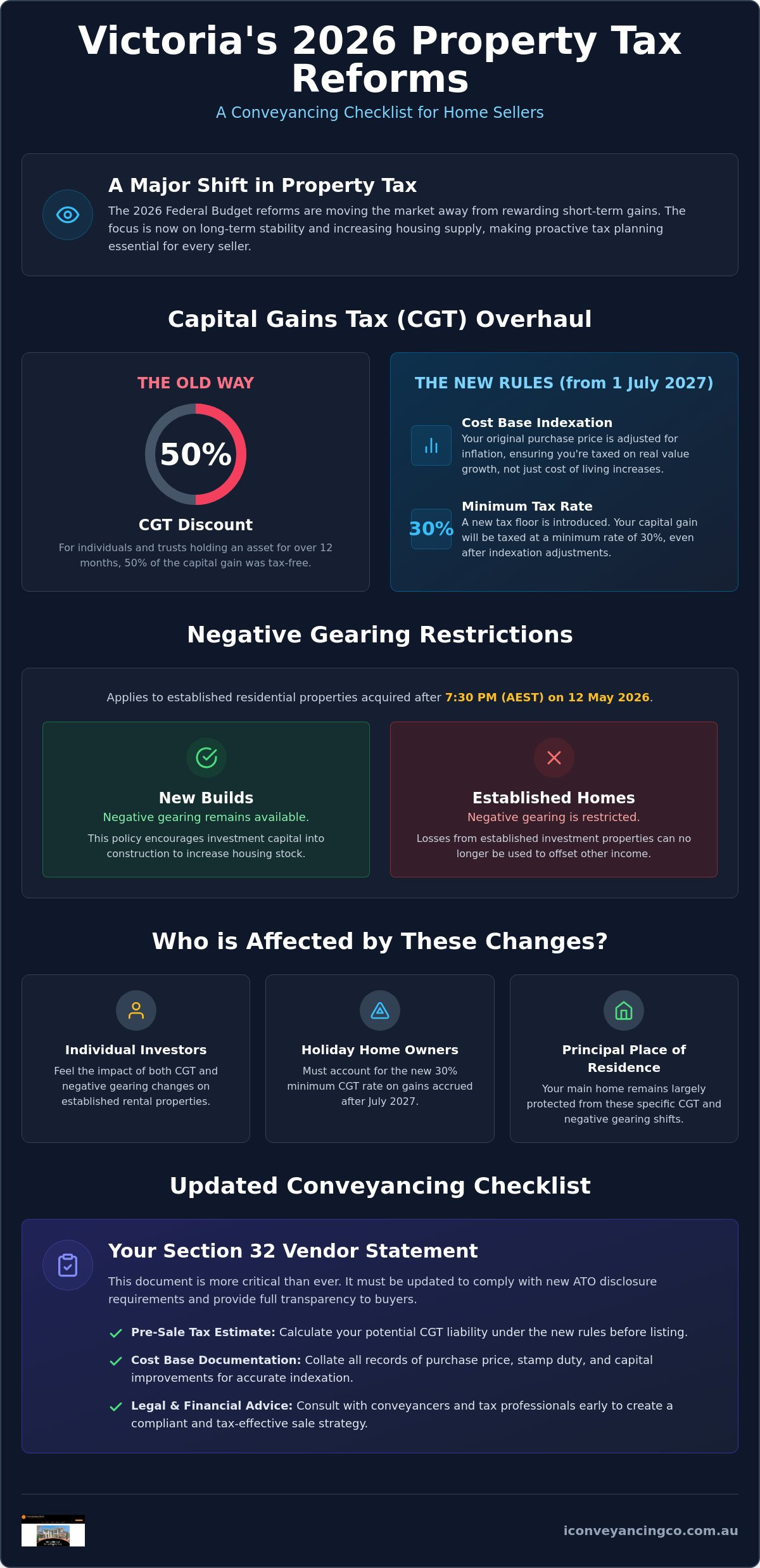
The federal government is using tax policy to address housing affordability. By phasing out the traditional 50% discount for individuals and trusts, the ATO aims to level the playing field for first-home buyers. This reform replaces the discount with a cost base indexation system and introduces a 30% minimum tax rate on gains accruing after July 2027. Understanding the history and mechanics of Capital Gains Tax in Australia is now essential for every vendor. Restricting negative gearing to new builds is another lever designed to push investment capital into construction rather than existing stock.
Not every seller faces the same impact. Individual investors in Geelong with established rental properties will feel the pinch of negative gearing limits if they bought after the May 2026 cutoff. Similarly, owners of holiday homes in Portarlington or St Leonards need to account for the new 30% minimum CGT rate on gains accrued after July 2027. However, your Principal Place of Residence (PPOR) remains largely protected from these specific shifts. These changes primarily target secondary residences and investment portfolios. Accuracy in your conveyancing checklist for selling a house victoria ensures you don't overlook these nuances during the pre-contract phase.
For decades, Victorian property owners relied on the 50% CGT discount to protect their profits. That safety net is being dismantled. From 1 July 2027, the automatic discount for individuals and trusts disappears. It's replaced by a system that requires more calculation and earlier preparation. If your conveyancing checklist for selling a house victoria doesn't include a pre-sale tax estimate, you risk losing a larger portion of your equity than expected. Understanding these new boundaries is the first step toward a successful settlement.
The ATO is shifting the focus from a flat percentage discount to a more granular assessment of your actual profit. This means your settlement figures will look different depending on when you bought the property and how long you've held it. To get an accurate picture, you should consult the official ATO guide to Capital Gains Tax. This resource helps you identify which costs can be added to your cost base to reduce the taxable gain. Our contract review and advice can further clarify how these figures impact your specific Sale of Land contract.
Indexation is the new standard. Instead of simply halving your profit, you now adjust your original purchase price for inflation over the time you owned the home. This protects you against paying tax on "gains" that were actually just the result of a rising cost of living. For example, if you sell a St Leonards investment property held for over five years, you'll calculate the inflation adjustment for each year of ownership. While this is more complex than the old 50% model, it ensures your tax liability is based on real value growth. Accuracy here is vital for your final bank balance.
The introduction of a tax floor is a major change for high-income earners and trusts. Even if your indexation reduces the taxable gain, the ATO now enforces a minimum contribution level. The 30% rate is the mandatory minimum tax for 2026 property sales. This floor applies to gains accruing after the 2027 cutoff, but it's essential to factor it into your 2026 planning. It interacts directly with your marginal tax bracket. If your income already puts you in a higher bracket, this floor ensures you can't use the old discount rules to drop below a 30% effective tax rate on your property profit. Clear communication with your conveyancer helps you prepare for these withholding requirements well before the keys change hands.
The 2026 tax reforms have created a clear divide in the Victorian property market. For the first time, the ATO is distinguishing between "new" and "established" homes for negative gearing purposes. If you're preparing a conveyancing checklist for selling a house victoria, you must understand how this distinction influences your pool of potential buyers. For properties acquired after 12 May 2026, negative gearing is restricted exclusively to new builds. This shift aims to drive capital into new housing supply, but it also changes the resale landscape for existing investment properties in areas like Geelong.
The good news is that grandfathering rules protect many current owners. If you held your investment property before the May 2026 cutoff, your existing negative gearing arrangements remain intact. This protection stays with you until you sell. However, once you list that established home, the next investor buyer won't be able to offset their losses against their general income. This reality makes your strategy for the 2026-27 selling season critical. You aren't just selling bricks and mortar; you're selling a specific tax status. Understanding how this affects your price expectations is a vital part of your preparation.
The ATO defines a new residential dwelling as a property that hasn't been previously sold as a residence or hasn't had a first-time residential use. This is a high bar. Generally, a property loses its "new" status once it's been lived in or held for more than five years. However, substantial renovations can sometimes reset this clock. If you've gutted and rebuilt a home, it may qualify if the work was extensive enough to be considered a new build under tax law. Proving this requires meticulous records. For those selling off-the-plan purchases in St Leonards, the tax advantages remain a powerful selling point that should be highlighted early in the process.
Since investors may face higher costs for established homes, your marketing should pivot toward the local Geelong owner-occupier market. These buyers are looking for a Principal Place of Residence (PPOR) and are less concerned with negative gearing benefits. Your conveyancing checklist for selling a house victoria should focus on making the property settlement ready for a family or first-home buyer. We help by verifying the "new build" status or lack thereof within your Section 32 Vendor Statement. Providing this clarity upfront builds trust and prevents delays. A transparent disclosure regarding the property's tax category allows buyers to proceed with confidence, ensuring a smoother path to a successful sale.
While previous sections explored the strategic shifts in CGT and negative gearing, those concepts must now be formalised in your legal documents. The Section 32 Vendor Statement is no longer a standard form. It's a critical disclosure tool. If your conveyancing checklist for selling a house victoria doesn't account for the 2026 Treasury Laws Amendment Act, you risk a buyer rescinding the contract before settlement. Accuracy in these disclosures is your best protection against delays and legal disputes.
Modern property sales require a proactive approach to tax transparency. The ATO now expects more granular data regarding property usage and ownership structures. This is especially true for trustees, who face new requirements to provide additional information in distribution statements from 1 July 2026. Ensuring your Vendor Statement reflects these 2026 ATO compliance standards isn't just about following the law; it's about providing the financial predictability that buyers and their lenders demand in a tighter market.
For contracts entered into in 2026, Victorian vendors are prohibited from passing on land tax to buyers if the sale price is below $10,700,000. This is a significant change from historical practices where land tax was often adjusted at settlement. Failing to disclose this correctly, or attempting to adjust land tax against these regulations, creates immediate legal friction. Our section 32 vendor statement guide highlights how these requirements have evolved. You must also include current property clearance certificates. While the fee for a certificate is only A$20, the cost of an error in these documents can be thousands in lost equity or delayed access to funds.
Digital settlement is the only way to manage 2026 compliance efficiently. Using PEXA allows for real-time tax management, ensuring the new 30% minimum rate is handled accurately within the settlement workspace. You must also manage the Foreign Resident Capital Gains Withholding (FRCGW) thresholds. Even as an Australian resident, you must provide an ATO clearance certificate for most sales to avoid a mandatory 12.5% withholding from your sale price. Applying for this early is essential to prevent funds from being frozen by the ATO at settlement. Collaborating with a conveyancer geelong ensures these certificates and PEXA workspaces are organised long before the keys change hands.
Don't leave your settlement figures to chance. Contact i.Conveyancing.Co to prepare your 2026-compliant Vendor Statement and protect your property equity.
Selling your home in Geelong, Portarlington, or St Leonards requires more than just a standard legal process. It demands a partner who understands the local landscape and the nuances of the 2026 tax reforms. We provide a personalised service that goes beyond basic paperwork. Our team focuses on your peace of mind, ensuring every item on your conveyancing checklist for selling a house victoria is handled with precision. With fixed-fee transparency, you can manage your 2026 sale budget with total confidence, knowing exactly what to expect from the start.
Fiona Barber brings over 20 years of Victorian property law experience to your side. This depth of knowledge is your best defence against the complexities of the 2026 Treasury Laws Amendment Act. We don't just process transactions; we protect your property equity. Our mobile and remote conveyancing model means we come to you. Whether you're at home on the Bellarine or working in the city, our service remains accessible and responsive. We use modern, tech-savvy tools to keep the process moving, but we never lose the grounded, human touch that defines our firm.
Signing a contract of sale is a major commitment. In the 2026 tax environment, a single clause can significantly impact your settlement figures. We provide essential pre-signing advice to protect your interests. Our team reviews special conditions and ensures your documentation aligns with the latest ATO requirements. This calm, reliable approach helps you avoid the stress caused by legislative noise. We make sure you understand the fine print before you commit. This proactive check ensures your conveyancing checklist for selling a house victoria starts with a solid foundation, preventing costly disputes later in the settlement period.
Digital efficiency is at the heart of our service. We use streamlined processes to ensure fast, stress-free property settlements for every client. If you're managing vacant land conveyancing st leonards, our local expertise is invaluable. We understand the specific requirements of the Bellarine Peninsula market, from established residential homes to vacant allotments. Your 2026 property plans deserve the highest standard of care and professional transparency. Reach out to us today. We're ready to have a reassuring chat about your sale and show you how a modern expert makes the difference.
The Victorian property landscape is shifting, but the path to a successful sale remains clear with the right preparation. The 2026 tax reforms, from the new 30% CGT floor to the restriction of negative gearing on established homes, require a more strategic approach to your settlement. By following a robust conveyancing checklist for selling a house victoria, you ensure that your Section 32 is compliant and your equity is protected from unexpected tax leakage. These changes are significant, yet they are entirely manageable with proactive planning.
You don't have to navigate these federal changes alone. With over 20 years of Victorian property law expertise, Fiona Barber provides the steady guidance needed to manage complex disclosures and urgent Section 32 Vendor Statements. Whether you're in Geelong, Portarlington, or St Leonards, our mobile service brings professional transparency directly to you. We turn legislative complexity into a straightforward, digital-first experience that prioritises your peace of mind.
Book a calm, professional consultation with i.Conveyancing.Co today and take the first step toward a stress-free settlement. Your property goals are within reach, and we're ready to help you achieve them with confidence.
No, your family home remains protected under the Main Residence Exemption. These federal tax reforms specifically target investment properties, secondary residences, and holiday homes. If the property you are selling is your Principal Place of Residence (PPOR), you generally don't need to worry about the new Capital Gains Tax (CGT) rates or indexation rules impacting your sale proceeds.
The 30% minimum tax rate is a mandatory floor for capital gains tax on property. It applies to gains accruing after 1 July 2027, replacing the old 50% discount system. This change ensures that high-income earners and trusts pay a consistent minimum level of tax on their property profits rather than using flat discounts to significantly reduce their liability.
Yes, you can continue to claim negative gearing if you bought your property before 12 May 2026. The government has grandfathered existing investments, meaning your current tax arrangements stay in place until you sell. Only residential properties acquired after the May 2026 cutoff are restricted to claiming negative gearing on new builds only.
Indexation adjusts your original purchase price to account for inflation over the years you've owned the property. Instead of a flat percentage discount, you increase your cost base by the inflation rate, which reduces the "real" gain the ATO taxes. While the full shift to indexation happens in 2027, your 2026 planning should account for how this protects your equity against rising living costs.
Tax changes only cause delays if your compliance paperwork isn't prepared in advance. Ensuring your conveyancing checklist for selling a house victoria includes early applications for ATO clearance certificates prevents mandatory withholding at settlement. Using digital platforms like PEXA allows your conveyancer to manage these tax requirements in real time, keeping your settlement on track and stress-free.
You don't necessarily need a completely new Section 32, but your Vendor Statement must be accurate at the time the contract is signed. If your property remains on the market as new land tax adjustment prohibitions or ATO disclosure rules take effect, your statement should be updated. An outdated Section 32 can give a buyer the right to rescind the contract.
For most residential property sales in Victoria, the threshold is $0. This means nearly every seller, regardless of their residency status, must provide an ATO clearance certificate before settlement. If you don't provide this certificate, the buyer is legally required to withhold 12.5% of the sale price and pay it directly to the ATO.
Selling before 1 July 2027 allows you to utilise the traditional 50% CGT discount for the entire gain. After this date, the new indexation system and the 30% minimum tax rate begin to apply to gains accrued from that point forward. Proactive sellers are currently reviewing their portfolios to determine if a sale before the 2027 transition provides a better financial outcome.